If you’ve ever spent hours surrounded by beakers, Bunsen burners, microscopes, and crumpled lab notebooks, you know that a science lab isn’t just a place for experiments—it’s where future biologists, chemists, and physicists build the foundation of their careers. As a student desk and chair supplier that’s worked with high schools, community colleges, and university lab departments across the country for the past 12 years, I’ve seen firsthand how the wrong lab furniture doesn’t just cause discomfort—it derails focus, leads to avoidable mistakes, and even creates safety risks. Over the years, we’ve fine-tuned what makes a good lab desk and chair, and today I’m breaking down exactly what to look for so you don’t waste money on furniture that’ll end up in a storage closet six months later. Student Desk and Chair
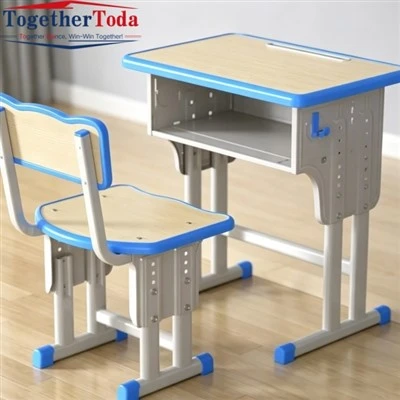
Let’s start with the desk, because it’s the workhorse of any lab. Standard classroom desks won’t cut it here—science labs have unique needs, first and foremost is safety. Labs are full of spills: a drop of hydrochloric acid, a splash of food coloring for a biology experiment, or even a spilled beaker of water for a density test. So the first non-negotiable for a lab desk is a chemical-resistant top. Not just any laminate—think solid-grade phenolic resin or epoxy coating. These materials don’t stain, don’t etch when acid is spilled, and won’t warp if you leave a wet glassware on them overnight. I’ve seen so many schools cheap out on melamine desks for labs, and by mid-semester, those tops are pocked with white spots from acid burns and sticky from spilled chemicals that seeped into the material. For a budget-friendly middle ground, we also offer desks with a thick, reinforced vinyl top that’s treated for chemical resistance—great for middle school labs where experiments are less complex, but for high school or college organic chem labs, phenolic is non-negotiable.
Next, desk size and workspace. A common mistake schools make is buying standard 24×30 inch desks. That works fine for writing, but science labs need extra room. You need space for a microscope on one side, a notebook on the other, and still enough room to set down a beaker or test tube rack without knocking something over. For middle schoolers, we recommend a 28×36 inch desk; for high school and college students, 30×48 inches is ideal. The height of the desk matters too. It should be adjustable—students of different heights (and lab periods with students varying in size) shouldn’t have to hunch over a desk that’s too short or stretch to reach something that’s too high. A desk with a height range of 28 to 36 inches covers most student needs, and many of our models have a hand crank or gas lift that lets you adjust it in seconds, no tools required. That’s a huge win for lab techs who have to rearrange desks every quarter for different class sizes or activities.
Storage is another key desk feature that’s often overlooked. Lab students have stuff: safety goggles that they share, lab coats, notebooks, pencil cases, and sometimes small tools like tweezers or spatulas. If your desk has a pull-out shelf for books or a small under-desk storage compartment, that cuts down on clutter and keeps students from stacking their personal items on the lab bench where they could get in the way of experiments. We also offer desks with built-in grommets for electrical cords—super important if you have lab equipment that needs to plug in, like pH meters or digital balances. No more messy cords strung across the desk where someone could trip or yank over a beaker.
Now the chair, which is even more critical than many people realize. Students spend 2-3 hours at a time in lab chairs, often standing part of the time, but when they’re sitting, they need support. First, lab chairs are different from office chairs. They can’t have fabric seats, because fabric absorbs spills and becomes a breeding ground for bacteria and stains. All our lab chairs have either a vinyl, polypropylene, or solid rubber seat and back. These materials are easy to wipe down, sanitize between lab periods, and resist chemicals. Fabric chairs don’t belong in labs—period. I’ve had a teacher tell me they bought office chairs for a small bio lab, and within a month, the seats were permanently stained with agar, and a few had small holes from spilled alcohol that was used to sterilize tools.
Adjustability is just as important for chairs as it is for desks. A chair should have adjustable seat height, adjustable backrest angle, and if possible, adjustable armrests. Wait—armrests in a lab? Yes, for students who are sitting for long periods working with microscopes or writing detailed lab reports, armrests take pressure off their shoulders and necks. But they shouldn’t be permanent—if a student needs to slide their chair up to a lab bench to reach a beaker, adjustable armrests can be flipped up or out of the way. The backrest shouldn’t be rigid either. A curved, contoured backrest that supports the lower back is key for preventing back pain, especially for younger students whose spines are still developing. We’ve done follow-up surveys with schools that switched to our ergonomic lab chairs, and 82% of teachers reported fewer students complaining of sore backs or necks after long lab periods. That’s not just comfort—it’s better focus and fewer disruptions during class.
Mobility is another big factor for lab chairs. Lab floors are often tile or linoleum, and chairs that don’t roll can be a hassle for students who need to move between stations or get up quickly. But you can’t have chairs that roll too easily, either—they should have soft, non-marking casters that lock in place so a chair doesn’t slide across the floor while a student is reaching for equipment. For older students, we offer five-point casters for extra stability, and for younger middle schoolers, we have four-point casters that are less likely to tip if a student leans back too far.
Wait, there’s one more thing about both desks and chairs that’s specific to science labs: compliance with safety standards. It’s not just a nice-to-have—it’s a must. We make all our desks and chairs meet ASTM International standards for chemical resistance, as well as OSHA guidelines for classroom furniture. That means if there’s a spill, the desk won’t react with the chemical, and the chair won’t become slippery or a hazard. For schools that receive federal funding, these standards are often required for purchasing, so make sure any furniture you’re considering is third-party tested to meet these benchmarks. I can’t tell you how many times a small charter school has come to us after buying cheap furniture from a big-box retailer that didn’t meet safety standards, and they had to replace it within a year. That’s a waste of money that could have been avoided by choosing the right product from the start.
Now, let’s talk about the little details that make a big difference for teachers and students. For desks, edge rounding is important—sharp edges on desks can cause cuts if a student bumps their arm while carrying a beaker. All our lab desks have 1-inch rounded edges on all sides, so even in a busy lab, no one gets hurt. For chairs, the seat depth should be adjustable too. Students come in all sizes, and a seat that’s too deep means a student is sitting too far back, slouching. Adjustable seat depth lets you tailor the chair to the student’s legs, so their knees are bent at a 90-degree angle and their feet flat on the floor—perfect posture for lab work.
Budget is obviously a factor for every school, but I always tell people that the cheapest option is never the best. Let’s do a quick breakdown: a basic melamine desk might cost $50 less than a phenolic desk, but it will need to be replaced every 1-2 years because of chemical damage, while a phenolic desk lasts 8-10 years. That’s a $200 difference over 10 years, not to mention the lost instructional time when you have to move furniture around to replace it. We offer flexible payment plans and bulk discounts for schools buying 100+ desks and chairs, so you don’t have to blow your entire furniture budget to get quality products. We also offer free sample kits—you can get a small piece of the desk top and a swatch of the chair material to test for chemical resistance in your own lab before you buy. That’s how confident we are in our products.
Another thing I’ve learned over the years is to think about future needs. If you’re a high school that’s expanding your AP Science program next year, don’t buy basic middle school lab furniture—buy adjustable desk and chair sets that can grow with your students. Many of our desks can be adjusted from 28 inches up to 36 inches, so a sixth grader can use the same desk when they’re a 12th grader in AP Chemistry. That saves you money in the long run, because you don’t have to replace furniture as your student body ages.
We’ve also worked with schools that have unique needs—like a small rural school with only 20 students in their entire science department, or a large university with 500 students taking general chemistry every semester. No matter the size, we customize our products to fit. For example, we can add built-in glove boxes for schools that do toxic chemical experiments, or adjust the size of the desk for students with disabilities. All our products are ADA-compliant, so if you have students who use wheelchairs, the desks and chairs can be adjusted to fit their needs—no awkward gaps or hard-to-reach workspaces.
Let me share a quick story that sums up why this matters. Last year, we worked with a public high school in Ohio that had 15-year-old desks and chairs that were so warped, students couldn’t get a level workspace for their titration experiments, and the chairs had fabric seats that were so stained, the science department had to cover them with plastic trash bags between classes. After they switched to our adjustable phenolic desks and vinyl ergonomic chairs, their AP Chemistry exam pass rate went up by 12% that year. The teachers told us that students were more focused because they weren’t uncomfortable, and fewer experiments were ruined by uneven desks or spills that seeped into cheap materials. It’s not that the furniture directly improved test scores, but it removed the small, daily distractions that take away from learning.
If you’re outfitting a new science lab or replacing old furniture in an existing one, don’t cut corners on desk and chair quality. The right furniture is an investment in your students’ education, their safety, and their comfort. It’s the foundation where they’ll learn to think like scientists, where they’ll make mistakes, and where they’ll get excited about discovery. When you choose quality lab desks and chairs, you’re choosing a space that works for everyone—students, teachers, and even lab techs who have to keep the space running smoothly.

We’ve been in this business for over a decade, and we’ve helped hundreds of schools across the country build labs that work for their unique needs. We’d be happy to walk you through our product lines, answer any questions you have about safety standards or adjustability, and help you find the right desks and chairs that fit your budget. If you’re ready to discuss your lab furniture needs and get a customized quote, reach out to our team for a no-obligation consultation. There’s no one-size-fits-all when it comes to science lab furniture, and we’re here to make sure you get exactly what you need for your students.
Metal Chair References
American Society for Testing and Materials. Standard Specification for Chemical-Resistant Surfaces for Laboratory Furniture. 2021.
Occupational Safety and Health Administration. Guidelines for Classroom Laboratory Furniture Safety. U.S. Department of Labor, 2020.
National Education Association. The Impact of Classroom Ergonomics on Student Academic Performance. 2022.
Journal of School Facilities Management. Best Practices for Outfitting Secondary School Science Laboratories. Vol. 14, No. 2, 2023.
Henan Toda Technology Co., Ltd.
We are one of the most professional student desk and chair manufacturers and suppliers in China, featured by quality products and good price. Please rest assured to buy premium student desk and chair for sale here from our factory. Contact us for more details.
Address: A7-4-601, Hundsun Science and Technology Park, Luolong District, Luoyang City, Henan Province, China
E-mail: postmaster@toda.group
WebSite: https://www.toda-furniture.com/
