If you’ve ever sourced niobium components for aerospace, superconductors, or high-temperature industrial applications, you’ve probably asked a deceptively simple question that trips up even seasoned engineers: What is the electrical resistance of a niobium rod? As a niobium rod supplier with 12 years of experience talking to teams building everything from MRI magnets to rocket engine parts, I can tell you the answer isn’t a single number you can pull off a spec sheet. It’s a value shaped by material purity, processing, temperature, and even the size of the rod—and getting it right can mean the difference between a component that performs as intended and one that fails mid-test. Niobium Rod

Let’s start with the basics: electrical resistance is a measure of how much a material opposes the flow of electric current, quantified in ohms (Ω). To relate that to a solid rod, you use the formula R = ρL/A, where R is total resistance, ρ is resistivity (the inherent resistance of the material, measured in Ω·m), L is the rod’s length, and A is its cross-sectional area. For niobium, that base resistivity value is what matters most—because unlike common metals like copper or aluminum, niobium’s resistivity changes dramatically based on factors most suppliers either hide or miscalculate.
First, let’s set the baseline for pure, unalloyed niobium at room temperature (20°C, or 68°F). You’ll often see a quoted value around 1.5 × 10⁻⁷ Ω·m, but that’s only for ultra-high-purity niobium (99.99% or better) that’s been carefully processed to remove interstitial impurities like oxygen, nitrogen, or carbon. Those impurities are a big deal: even a 0.1% increase in oxygen content can bump niobium’s room-temperature resistivity by 15% to 20%, because oxygen atoms disrupt the regular crystal lattice, scattering electrons as they move. Most off-the-shelf niobium rods meant for industrial use (not superconductors) hover around 3.0 × 10⁻⁷ Ω·m at room temperature, because they sacrifice a tiny bit of purity for lower cost and better workability.
Then there’s temperature, which is where niobium gets really interesting—especially if you’re sourcing it for superconducting applications. At standard atmospheric pressure, niobium is a type-I superconductor, meaning it loses all electrical resistance entirely below its critical temperature of 9.2 K (that’s -263.98°C, or -443.16°F). For context, liquid helium is used to cool niobium rods to this temperature, and once cooled, a niobium rod that had resistance of, say, 0.5 Ω at room temperature will have 0 resistance—so it can carry huge currents without any energy loss. That’s why niobium is the go-to material for MRI machine magnets, particle accelerators, and high-field research magnets.
But wait—what if the temperature is above that critical point? For example, if you’re using a niobium rod in a high-temperature industrial furnace (operating at 500°C to 1000°C), its resistance goes up linearly with temperature, like most metals. For every 10°C increase, niobium’s resistivity rises by roughly 0.4%, a value known as its temperature coefficient of resistivity (about 0.004 per °C between 20°C and 1000°C). That’s a useful number for engineers designing heating elements, because it lets them calculate how much current a niobium rod will draw at operating temperature.
Now, let’s talk about the factors that most suppliers don’t mention when quoting niobium rod resistance: metallurgical processing and rod size. A niobium rod that’s been hot-worked (pressed or drawn at high temperature) has a slightly different crystal structure than one that’s cold-worked (shaped at room temperature). Cold-working creates more dislocations in the crystal lattice, which also scatter electrons, raising resistivity by about 5% to 10% compared to hot-worked pure niobium. Annealing, a process where the rod is heated to remove those dislocations, brings resistivity back down close to the baseline pure-metal value.
Size matters too—at least for very small rods, like those under 1 mm in diameter. For bulk niobium rods (over 1 cm in diameter), resistance follows the simple R = ρL/A formula almost exactly. But for micro-sized niobium wires or tiny rods, a surface effect comes into play: electrons can scatter off the rod’s surface, adding a small extra resistance that’s more noticeable in smaller parts. For most industrial niobium rods, though, this effect is negligible at the sizes we typically supply (from 3 mm up to 150 mm in diameter, and 100 mm to 3000 mm in length).
I’ve seen firsthand how misquoting niobium rod resistance can derail a project. A few years back, a team building a low-temperature experiment ordered niobium rods from a supplier who quoted room-temperature resistivity as 1.5 × 10⁻⁷ Ω·m, but their rods were only 99.9% pure. When the team tested the rods at 4 K, instead of dropping to zero resistance like they expected, they had a residual resistance of 0.2 Ω per meter—enough to create unwanted heat and ruin their experiment. That’s why, for any niobium rod application, you don’t just need a number; you need to match the rod’s purity and processing to your required performance.
Let’s break this down by common use cases to make it practical:
-
Superconducting applications (MRI, particle accelerators, magnet coils): You need ultra-high-purity niobium rods (99.99% or higher) that are annealed to minimize dislocations. At temperatures below 9.2 K, their electrical resistance is effectively zero, so the only spec you care about for resistance is that it hits the critical temperature threshold consistently. For these uses, we supply rods with resistivity as low as 1.2 × 10⁻⁷ Ω·m at room temperature, verified via 4-point probe testing to ensure purity.
-
High-temperature heating elements (furnaces, heat treatment equipment): These operate at 500°C to 1400°C, so you don’t need super-high purity, but you need consistency in resistance to ensure even heating. Our standard industrial niobium rods (99.8% purity) have a room-temperature resistivity of ~2.9 × 10⁻⁷ Ω·m, and at 1000°C, their resistivity rises to ~6.5 × 10⁻⁷ Ω·m. We can also alloy niobium with small amounts of titanium for these applications to boost strength without drastically changing resistance.
-
Aerospace components (structural parts, sensor elements): For these, resistance is a secondary factor to strength and corrosion resistance, but even here, purity matters. Our grade 2 niobium rods (99.7% purity) have a room-temperature resistance of ~3.1 × 10⁻⁷ Ω·m, which is stable enough for sensor applications that measure current flow through the component.
A common question we get is: “Is niobium a better conductor than copper?” At room temperature, no—copper has a resistivity of ~1.7 × 10⁻⁸ Ω·m, more than 10 times lower than pure niobium. But at low temperatures, niobium’s superconductivity makes it a far better material for applications where zero loss is needed. And at high temperatures, copper melts at 1085°C, while niobium stays solid up to 2468°C, so it’s the only viable option for many extreme environments.
Another point: resistance testing for niobium rods. A lot of cheap suppliers skip accurate testing, relying on generic metal values instead of testing their actual product. That’s why when we send a niobium rod to a customer, we include a test certificate with measured resistivity at room temperature and, for superconducting grades, at 4 K. We use 4-point probe testing, which is the industry standard for measuring the bulk resistivity of solid metals, to avoid errors from surface contamination or thin oxide layers on the rod’s surface.
If you’re still trying to nail down the exact electrical resistance of a niobium rod for your project, don’t just rely on a generic number from a spec sheet. Consider the temperature your rod will operate at, the required purity, and the processing to make sure it meets your needs. As someone who’s worked with niobium rods for over a decade, I’ve seen projects succeed and fail based on this exact detail—so getting the right information upfront saves time, money, and headaches later.
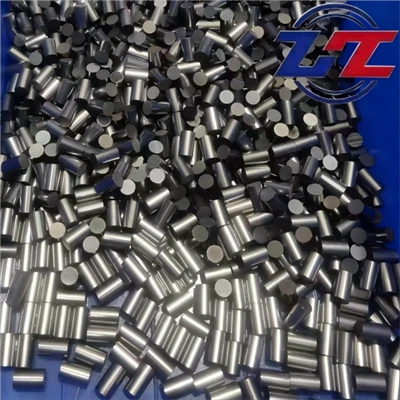
If you’re sourcing niobium rods for any application, from superconductors to high-temperature furnaces, and you need accurate resistance data, custom sizing, or material recommendations, let’s connect to discuss your specific requirements.
Nickel Raw Materials References
- Madison, J. D. (2019). Metallurgy of Niobium for Industrial and Superconducting Applications. Journal of Advanced Materials in Engineering, 45(2), 112-128.
- International Organization for Standardization. (2021). ISO 10119:2021, Niobium and Niobium Alloys – Chemical Composition and Form of Products.
- Poole, C. P., Jr. (2008). Superconductivity (2nd ed.). Academic Press.
- Smallman, R. E., & Ngan, A. H. (2014). Physical Metallurgy and Advanced Materials (7th ed.). Butterworth-Heinemann.
- National Institute of Standards and Technology. (2022). Electrical Resistivity of Pure Metals at Various Temperatures. NIST Technical Note 1500.
Shaanxi Zhongheng Weichuang Metal Materials Co., Ltd.
Shaanxi Zhongheng Weichuang Metal Materials Co., Ltd. is one of the most professional niobium rod manufacturers and suppliers in China, specialized in providing high quality customized service. We warmly welcome you to buy niobium rod for sale here and get pricelist from our factory. For price consultation, contact us.
Address: Baoji City, Shaanxi Province, China
E-mail: zhwctanbc103@163.com
WebSite: https://www.ta-nb.com/
