If you’ve ever watched a tattoo artist glide a pen-like device over skin, leaving crisp, even pigment lines, you might think that level of control is just “natural talent.” As a tattoo pen supplier, I can tell you that’s only half the story. The other half is how the artist pairs proper technique with a pen that’s well-suited to their style—plus small, consistent habits that keep every stroke intentional. For years, I’ve worked closely with artists of all skill levels, from apprentices just holding their first machine to veteran masters doing cover-ups on high-profile clients. Most of the questions I get aren’t about “the best pen on the market” (though that matters) — they’re about how to actually control that pen, every single time, no matter what the project throws at them. Tattoo Pen

Let’s start with the foundation: how you hold the pen. I see so many new artists default to a death grip, like they’re holding a marker they’re scared will slip. That’s a mistake. A tattoo pen is designed to be balanced, so your grip should be loose enough to let the tool move with your hand, not against it. Think of holding a paintbrush for watercolor, not a wrench. For linear work (like outlines or fine line shading), I recommend a “pencil grip” — pinching the pen between your thumb, index, and middle fingers, resting it lightly on the pads of your fingers, not your knuckles. This gives you tiny, precise movement for tight curves and small details, like the fine lines in a mandala or the outline of a bird’s eye. For larger areas, like a full back piece’s background shading, a “fountain pen grip” works better: wrap your fingers around the barrel of the pen, so your whole hand moves in a smooth, sweeping motion, not just your wrist. This reduces fatigue too — tattooing is physically demanding, and a tight grip after an hour will lead to shaky lines. I always tell artists to do a 10-second grip test before starting: if you can feel tension in your forearm or shoulder, you’re holding too tight. Adjust, and you’ll notice an immediate difference in how steady your strokes are.
Next, weight distribution on the pen itself. Not all tattoo pens are created equal, and as a supplier, I’ve seen firsthand how a pen that’s too heavy or too front-heavy can throw off an artist’s control. If your pen is weighted too far forward (near the needle assembly), you’ll find yourself leaning forward to compensate, leading to uneven pressure and tired hands mid-project. Look for pens with balanced weight distribution — most quality models keep about 70% of their weight at the center, so it feels like an extension of your hand, not a separate object. For artists who prefer finer work, there are compact, lightweight pens (around 40 grams) that are easy to maneuver for hours. For those who do heavy shading or have larger hands, a slightly heavier pen (55 to 60 grams) can provide more stability without feeling cumbersome. Another tip here: check the ergonomics of the pen’s grip area. Rubberized or textured grips aren’t just for comfort — they prevent the pen from slipping when your hands get sweaty (which they will, even in cool rooms). Many new artists overlook this, but a single slip mid-outline can ruin hours of work.
Then there’s needle depth adjustment, which is make-or-break for control. Too shallow, and the pigment won’t deposit properly; too deep, and you’ll hit tissue that causes bleeding, blowout, and shaky lines. Most tattoo pens have a adjustable cam or needle stop that lets you tweak depth in 0.1mm increments, and mastering this setting is non-negotiable. I recommend practicing on synthetic skin or fruit (like a piece of banana, which has a similar density to human skin) before ever working on a client. Start with 0.3mm depth for outlines — this is the sweet spot for most skin types, as it penetrates the upper dermis where pigment stays without going too deep. For shading, you’ll want to adjust to 0.5mm to 0.8mm, depending on how bold you want the color to be. Here’s a common trick I share with apprentices: after setting the depth, lightly tap the needle against the surface of the synthetic material. If it leaves a tiny, consistent indent without breaking the surface, you’re good to go. If it punctures all the way through, back it off a little. This practice builds muscle memory, so you don’t have to second-guess the depth mid-tattoo.
Pressure control is the part that trips up even experienced artists. You might have a steady grip and the right depth, but if you’re pressing too hard or too soft, your lines will look uneven. A lot of new artists think you need to “force” the pen into the skin, but that’s not true — the needle’s upward and downward motion (usually 80 to 120 strokes per second, depending on the pen) does most of the work. Your job is to guide the pen, not push it. Think of the pressure like gliding a book across a table: you don’t press hard, you just keep it moving at a consistent pace. For outlines, keep your pressure light enough that you can feel the skin move slightly under the pen. If you’re leaving faint trail marks from the needle as you go, that’s a sign you’re applying too much pressure. For shading, you can apply a little more pressure, but still not so much that the pen digs in. I suggest practicing on synthetic skin to track this: drag the pen in a straight line, and if the pigment is deposited evenly across the entire line, your pressure is consistent. If some parts are thicker and others are thin, adjust how hard you’re pressing until it’s uniform.
Speed of movement is another key factor that ties into all the above. Each tattoo pen has a certain frequency of needle strokes, and your stroke speed needs to match that to keep control. For example, a pen with a higher stroke frequency (100 to 120 SPM) works best with a slightly faster hand movement, while a lower frequency pen (80 to 90 SPM) needs a slower, more deliberate stroke. If you move too fast for your pen’s SPM, the needle won’t deposit pigment evenly, and you’ll get gaps in your line. If you move too slow, you’ll build up too much pigment, leading to blowout or overworked skin. Again, practice is here is critical. Start with simple shapes — circles, straight lines — on synthetic skin, and adjust your speed until each stroke looks smooth. Once you have that down, try more complex shapes, like curves or angles, to build consistency.
Now, let’s talk about the pen itself, since as a supplier, I know that investing in a quality tool isn’t optional. Cheap, knock-off tattoo pens might seem like a good deal at first, but they often have inconsistent weight, wobbly needles, or poor depth adjustment, all of which make control nearly impossible. A quality pen will have a steady motor that doesn’t vibrate excessively — too much vibration in the pen translates to shaky lines in your work. It will also have a secure needle grip that doesn’t slip or shift during use. I’ve had artists tell me they’ve saved $100 on a pen, only to have the needle come loose mid-session, ruining a custom piece and losing a client. That’s a risk no artist needs to take. When choosing a pen, look for one that fits your hand size and your style of tattooing: if you do mostly fine line work, a compact, lightweight pen is better; if you do large-scale shading, a slightly heavier, more stable model is the way to go.
One thing I always emphasize is consistent maintenance of your pen, because a well-cared-for pen is a controllable pen. After every use, disassemble the grip and needle assembly, clean all parts with isopropyl alcohol, and oil the motor and moving parts (as per the manufacturer’s instructions) to keep it running smoothly. A pen with a dirty motor will vibrate unevenly, which throws off your control. Also, regularly check the needle and tube for wear — bent needles or cracked tubes can cause uneven pigment flow and shaky strokes. I recommend having at least one backup pen for every session, so if your main one has an issue, you don’t have to pause mid-tattoo to fix it, which can break your rhythm and lead to mistakes.
Finally, don’t underestimate the role of practice and physical conditioning. Controlling a tattoo pen isn’t just about hand skill — it’s about forearm and wrist strength, and staying relaxed during long sessions. If you’re tense, your lines will be tense. Before starting a tattoo, do a quick wrist stretch: rotate your wrist in small circles for 10 seconds, then stretch your fingers wide and hold for another 10. This gets your blood flowing and reduces tension. I also suggest doing 10 minutes of finger dexterity exercises a few times a week, like holding a pen and drawing tiny dots or lines, to build muscle memory. Over time, these small habits will make controlling your pen feel like second nature.
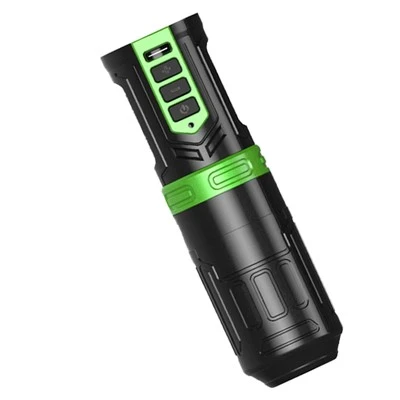
For all the artists I work with, the goal is to make control feel effortless, so you can focus on the art, not the tool. If you’re a studio owner or independent artist looking to upgrade your equipment to pair with the techniques I’ve outlined, we partner with tattoo professionals to match them with pens that fit their unique style and workflow. We understand that every artist’s needs are different, so we take the time to listen to what you’re looking for, whether that’s a lightweight pen for fine line work, a high-speed model for large projects, or something in between. To learn more about our tattoo pens and custom solutions for your studio, don’t hesitate to reach out for a procurement consultation.
Tattoo Machine Components Reference:
- “Tattoo Equipment and Techniques: A Practical Guide,” National Tattoo Association, 2021
- Ergonomics of Hand-Held Tattoo Devices: Implications for Artist Performance and Injury Prevention, Journal of Occupational and Environmental Hygiene, 2019
- Needle Depth and Pressure Dynamics in Tattooing, International Journal of Dermatology, 2020
Zhuji Taituo Machinery Technology Co., Ltd.
Zhuji Taituo Machinery Technology Co., Ltd. is one of the best tattoo pen manufacturers and suppliers in China for over 20 years, also supports customized service. Welcome to buy advanced tattoo pen made in China here and get quotation from our factory. For price consultation, contact us.
Address: 101, Building 12, Youdi, No. 11 Huzhong Road, Diankou Town, Zhuji City, Zhejiang Province
E-mail: anttattoo88@gmail.com
WebSite: https://www.antinktattoo.com/
